Last updated September 2026
Buy an Audi, a BMW or a Land Rover in Franklin and the same question turns up around the first service. The nearest franchise dealer is a drive up the motorway, the booking is weeks out, and there is a workshop fifteen minutes away that says it does European cars. The worry is always the same: if something goes wrong later, has using the local workshop cost you your cover?
★View the Best European Car Specialists in Pukekohe→The short answer
No. Nothing in New Zealand law ties you to a dealership to keep a factory warranty alive. The Motor Trade Association sets out how this works: using a qualified independent workshop is low risk as long as the servicing follows the manufacturer’s specifications, the right parts and fluids go in, and the service intervals are kept.
The dividing line is not dealer against independent. It is done properly against not.
What a factory warranty actually asks of you
Your rights under the Consumer Guarantees Act do not disappear because you chose someone other than the selling dealer. What a manufacturer can do is decline a claim where the repair itself caused the fault, or where the servicing was not done to schedule or to specification.
That makes your paperwork the thing worth protecting. Keep every invoice, and make sure each one records the date, the odometer reading, what was done, and which parts and fluids were used. A folder of those is what answers the question if it is ever asked. It is also the first thing a buyer will want to see when you sell.
Mechanical breakdown cover works differently
This is where people get caught, because a mechanical breakdown policy is not the factory warranty and does not follow the same rules.
Policies like Autosure and Protecta run approved repairer networks. Autosure’s own terms state that all repairs must be carried out by an authorised repairer, and that the workshop needs to contact them so the breakdown can be assessed before the work goes ahead. Start a repair first and ask afterwards and you can find yourself holding the bill.
If you have mechanical breakdown cover, check the workshop is on the network when you book, not once the car is in pieces.
The parts question
Ask what is going on the car and why.
Genuine parts come in the manufacturer’s box. OE parts are made by the same supplier that produced the part for the manufacturer, without the badge and usually without the badge’s price. Aftermarket is everything else, and it runs from excellent to false economy.
There is no single right answer to this. There is a right answer per part, and a workshop that can explain which one it is fitting and what the trade-off is has told you something useful about how it works.
Coding is the part people underestimate
On a modern European car, fitting the part is often the smaller half of the job. Batteries have to be registered so the charging system knows it is dealing with a new one. Particulate filter counters need resetting. Replacement modules have to be coded to the vehicle. Miss that step and the mechanical work can be perfectly sound while the car still sits there with a light on.
So put it to any workshop specifically rather than generally, before you hand over the keys: which diagnostic system do you run, and can you code to my VIN? A shop set up for routine servicing and diagnostics on European vehicles will answer without hesitating.
What Franklin driving does to a European car
Local conditions shape what goes wrong here.
Short trips are the big one. A diesel needs sustained heat to burn off its particulate filter, and a car doing five minutes into Pukekohe and back never gets there. Owners see a DPF warning on a vehicle that is otherwise perfectly healthy, purely because of how it is being driven.
Unsealed and patched rural roads work through suspension bushes, shocks and steering components faster than smooth motorway kilometres do. Towing a float or a trailer loads up transmissions and cooling systems specified for lighter duty.
Plenty of Franklin households run a diesel Land Rover, Discovery or similar that does farm tracks during the week and the school run as well, which is close to the hardest combination you can give a modern European drivetrain. Most of the common repair work on these vehicles traces back to one of those three things.
A warrant of fitness is not a service
Worth separating, because the two get conflated.
A WOF is a safety inspection against a set standard at a point in time. It says nothing about whether your cambelt is due, whether your transmission fluid has gone past its life, or whether a filter is quietly loading up. A car can pass its warrant in the morning and genuinely need attention that afternoon.
Questions worth asking before you book
- Which diagnostic system do you run, and does it code to my VIN?
- Are you an authorised repairer for my mechanical breakdown policy?
- Genuine, OE or aftermarket for this part, and why that one?
- Will I get the fault codes and a written record of what was done?
- If a part has to come from Europe, what is the realistic lead time?
Any workshop worth using will answer all five without getting defensive.
Where Euro MD fits
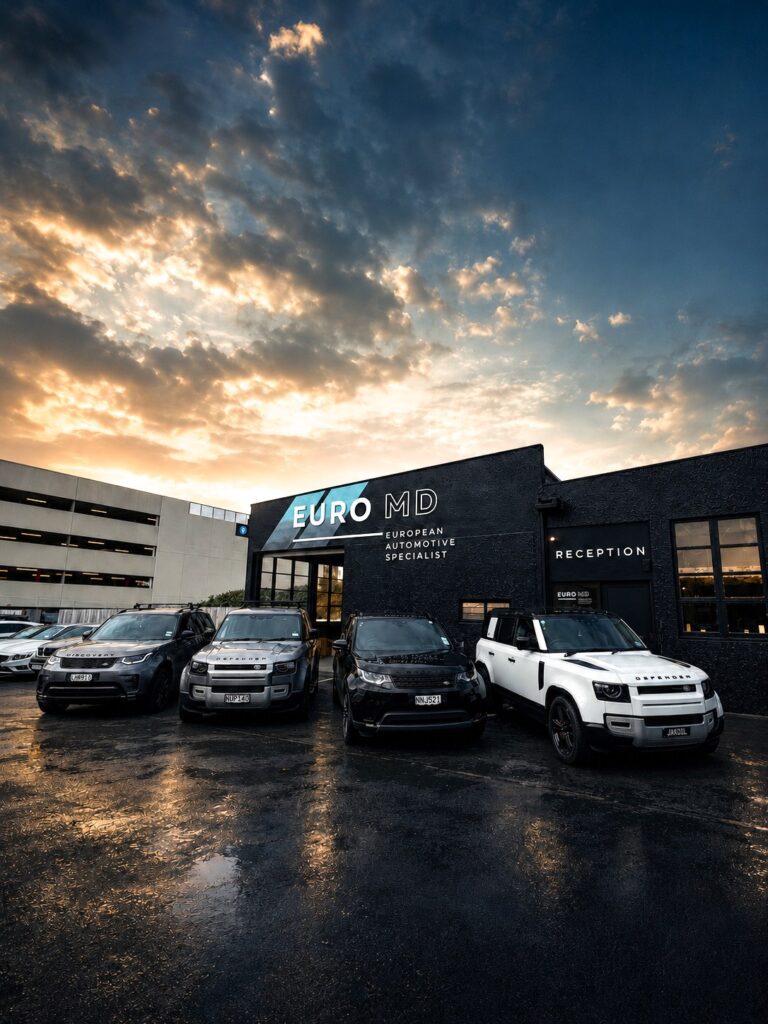
Euro MD is a family-run workshop in Pukekohe, started in early 2023 by owner Bradley after more than two decades working in European specialist workshops across Auckland. They work on VW, Audi, BMW, Mercedes, Jaguar and Land Rover, with Land Rover a particular focus.
On the points above: they are an authorised repairer for Autosure and Protecta mechanical breakdown warranties, so a claim can be assessed and authorised without moving the car somewhere else. They run dealer-level diagnostic equipment with full OEM diagnostics and coding, which covers the module and VIN side of the job. Alongside servicing and repairs they also handle ECU tuning, remapping and performance work, including DPF, EGR and AdBlue solutions.
If you are weighing up where to take a European car in Franklin, the questions above are the ones to ask, whoever you end up calling.