Last updated September 2026
Car maintenance would be easy if everything happened at once. It does not. A warrant runs on one clock, a service on another, and a cambelt on a third that most people forget about entirely until it is expensive. Here is what runs on what, and roughly when to expect it.
★View the Best Mechanics in Pukekohe→Warrants: check the rule rather than assume it
Warrant frequency is set by the vehicle’s age and its date of first registration, not by how far you drive. It is also the one interval in this article that is genuinely in flux, so it is worth looking up rather than going on what you remember.
The Government has announced changes to light vehicle inspections that start from 1 November 2026 and phase in through 2027. In broad terms, vehicles between four and fourteen years old move from an annual warrant towards a two-yearly one, the oldest vehicles move from six-monthly to annual, and new vehicles get their second warrant later than they do now. Penalties are moving the other way: the infringement fee for driving on a warrant that expired more than two months ago is going from $200 to $350, and the penalties for non-compliant wheels and tyres are rising as well.
The practical upshot is that a rule of thumb you learned a few years ago is probably wrong, and a lot of published advice is out of date with it. NZTA holds the current table and updates it as the changes take effect. Any approved inspecting organisation can issue a warrant, so you are not tied to where you bought the car.
One thing that has not changed: it is your job to keep the vehicle in warrant condition the whole time, not just on inspection day. Tyres that pass in the morning still need replacing when they reach the minimum tread, whenever that falls.
A warrant is a safety check, not a health check
This one catches people out, because passing feels like a clean bill of health and it is not.
A warrant does not look at your engine, clutch, gearbox or differential. It does not check lubricant levels or the condition of your oil. It does not measure how much life is left in your brake pads, only whether the brakes work today. It does not cover rust in non-structural areas or the state of your paint.
All of which means a car can pass in the morning and still be due for real work. It is why combining the two makes sense: book the warrant alongside a service and anything found gets fixed and re-inspected in one visit rather than two.
Servicing: kilometres or months, whichever lands first
Service intervals come from the manufacturer, not from a general rule, and they vary widely between a modern diesel and a fifteen-year-old petrol. Your owner’s manual or your service book has the number.
What is consistent is the “or” in the interval. Every schedule reads as a distance or an elapsed time, whichever comes first, and the time half is the one people ignore. A car doing 6,000 km a year still needs its oil changed, because oil degrades sitting in a sump as well as running through an engine. Low-mileage cars that only do short trips are often harder on oil than high-mileage ones, not easier.
If you genuinely do not know what yours is due for, the service history and how you actually use the car will tell a workshop more than the odometer alone.
Cambelts: 100,000 km or five years
This is the expensive one to get wrong.
The interval is 100,000 km or five years, whichever comes first. Some engines run two belts, a cambelt and a balance belt, so the job is not always the same job. Not every car has a belt at all, because many modern engines use a timing chain instead, which is designed to last the life of the engine.
The reason it matters more than any other interval is what happens when a belt lets go. On a lot of engines the valves and pistons occupy the same space at different moments, and the belt is what keeps them from meeting. Lose it at speed and you are not looking at a belt replacement, you are looking at an engine. Ask a workshop what your make and model runs if you are not sure, because the answer is either “nothing to worry about” or “book it in”, and both are worth knowing.
Brakes, tyres and batteries run on wear, not dates
These three have no schedule at all, which is why they get noticed late.
Brake pads wear according to how you drive. A Pukekohe car doing motorway kilometres to Auckland will go through pads far more slowly than one doing school runs and town driving all week, even at identical odometer readings. Tyres wear the same way, and they also age out: rubber hardens over the years whether or not it is being used, so tread depth alone does not tell you everything.
Batteries are the most seasonal of the three. They usually fail on the first genuinely cold morning of the year, but the damage was done over the preceding months. A battery that has been slow to turn over is telling you something.
What Franklin driving does to the timeline
Where you drive changes the intervals in practice.
Unsealed and patched rural roads work through suspension bushes, shocks and steering components faster than smooth motorway kilometres. Gravel and grit also find their way into places they were not designed to reach.
Towing changes the calculation. A float, a boat or a loaded trailer raises the working temperature of a transmission and a cooling system that were specified for lighter duty, and heat is what shortens their lives.
The Auckland commute cuts the other way. Long steady runs are the easiest work an engine ever does, but they pile on kilometres quickly, so the distance half of every interval arrives sooner than the calendar half. Two Pukekohe cars of the same age can be a full service apart.
What to sort before you book anything in
- Find your service book or manual and check what interval the manufacturer actually specifies
- Ask whether your engine runs a cambelt or a chain, and if it is a belt, when it was last done
- Ask for an estimate in writing, and for anything found mid-job to be approved by you before it goes ahead
- Ask what happens if it fails the warrant, and whether the re-inspection is included
- If you cannot be without the car, ask about a courtesy car when you book rather than on the day
Any decent workshop will handle all five without making it difficult.
Where Auto Super Shoppe Pukekohe fits
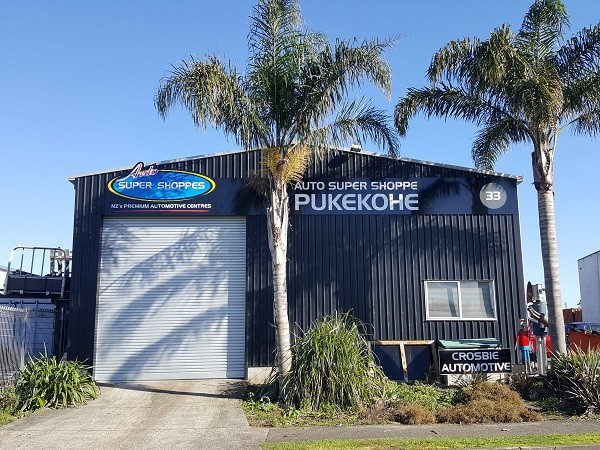
Auto Super Shoppe Pukekohe is at 33 Crosbie Road, owned and operated by Aaron Dutton. The workshop was established in 2004 and Aaron took over as owner in 2017, running a team with more than 40 years of collective experience between them. It is MTA approved and part of the Auto Super Shoppe network.
On the points in this article, two things are worth knowing. They are a VTNZ Certified Repairer, which means the warrant inspection is an independent VTNZ assessment and any repairs needed to pass it can be done in the same place rather than sending you somewhere else and back. And repairs and costs are approved by you before the work goes ahead, which is the answer to the question about written estimates above.
The work covers petrol and diesel servicing, repairs and maintenance, transmission and air conditioning servicing, exhausts, tyres stocked and fitted in most sizes, and their work is guaranteed and covers new car warranty. They are open Monday to Friday, with Saturdays by appointment.
Whoever you use, the clocks in this article keep running. Knowing which one your car is closest to is most of the job.