Last updated November 2026
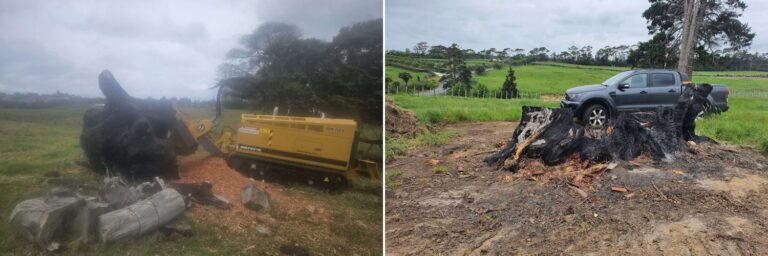
Cut down a big tree on a Franklin farm or lifestyle block and you are left with the hard part. An old pine, macrocarpa or gum can leave a stump a metre or more across, with a root flare that spreads well beyond the trunk and laterals running out under the paddock. Removing a tree stump that size is a different job from lifting a small garden stump, and the method you choose decides how much ground gets torn up, how long it takes and what you are left to deal with afterwards.
★View the Best Stump Grinding in Pukekohe→This guide covers the realistic options for a large stump around Pukekohe, what each one leaves behind, and what to sort out before anyone starts.
Why a Big Stump Is a Different Job
A small stump is mostly trunk. A large, decades-old stump is mostly root system: a wide flare at ground level, thick anchor roots heading down, and lateral roots that can run a long way in every direction. Hardwoods such as eucalyptus are dense and slow to cut, and old shelterbelt pines often carry stones and fencing wire grown into the base.
That is why the advice that works for a backyard (dig a trench, cut the roots, lever it out) stops working on farm stumps. The question becomes which machine, and how much of the surrounding ground you are prepared to disturb.
Your Options for Removing a Tree Stump
Digging out by hand
- Suits
- Small garden stumps
- What to watch for
- Impractical once the stump is more than a hand’s width or two across
Excavator pulling the stump
- Suits
- Sites that are being earthworked anyway
- What to watch for
- Leaves a large hole, disturbs a much wider area and leaves a heavy root ball to dispose of
Hiring a stump grinder
- Suits
- A few small to medium stumps with easy access
- What to watch for
- Hire machines are usually compact, so a large stump can take a long time, and you carry the risk of running it
Chemicals or letting it rot
- Suits
- Stumps that are out of the way and can wait
- What to watch for
- A large stump can take years to break down, and some species keep sending up shoots
Burning
- Suits
- Rarely the right answer
- What to watch for
- Fire risk, smoke and root fires underground; check the rules before lighting anything
Professional stump grinding
- Suits
- Large stumps, rows of stumps and tidy finishes
- What to watch for
- Needs machine access, and someone to check for underground services first
If you are thinking about burning, check the current fire season and whether you need a permit at Fire and Emergency’s Check It’s Alright site first. Stumps can smoulder below ground long after the visible fire is out.
Is It Cheaper to Grind or Remove a Stump?
For a large stump, grinding usually involves less work overall, because the root plate stays in the ground and only the stump and the top of the roots are turned into chip. Pulling a stump out means digging around it, lifting a very heavy root ball, filling the hole and getting rid of the stump, which is where the time and cost add up.
Operators quote per job rather than per stump on a fixed rate, and the price turns on a handful of things:
- Size and species. The diameter at ground level matters most, and dense hardwoods take longer than softwoods.
- Depth. Grinding deep enough for new fence posts or a building platform takes longer than grinding for lawn or pasture.
- Access. Gate widths, slopes, soft ground and the distance from where the machine can be unloaded.
- How many stumps. Several stumps on one property, done in one visit, is usually more efficient than booking them one at a time.
- The chip. Whether it is raked back into the hole, spread as mulch or carted away.
Why Not Just Leave the Stump?
Sometimes leaving it is fine. A stump in the corner of a paddock that nothing needs to pass over can be left to weather away. Problems start when the stump is in the way.
Mowing, fencing and machinery
Stumps along an old fence line stop a new fence going in straight, and stumps in a paddock are something every tractor, mower and quad has to steer around. Hidden ones in long grass are a hazard to machinery and to people.
Regrowth
Poplar, willow and some other species send up shoots from a stump left in the ground. Grinding below ground level removes the growing point, which is what stops the regrowth.
Using the land
A row of stumps can take a whole strip out of use. Clearing it gets that ground back for pasture, planting, a track or a shed.
Before Anyone Starts Grinding
Find out what is underground
Water lines, power cables and drainage often run closer to old trees than people expect. Request plans for the property from beforeUdig, the free national service, and point out anything you know about, such as a trough line or an old septic system.
Think about access
Franklin’s heavy winter rain can make paddocks too soft for a loaded trailer and a tracked machine. Drier months often mean less damage to the ground on the way in and out, so it is worth booking rural work with that in mind.
Decide what the ground is for next
Tell whoever is quoting what you plan to do with the spot: grass it, plant it, fence through it or build on it. That sets how deep the grinding needs to go.
Getting a Large Stump Quoted With Apex Stump Grinding
Apex Stump Grinding is run by Gary, who has been self-employed for more than 20 years and comes from a rural work background. The business works across Pukekohe and its surrounding areas, and handles everything from small yard stumps to large farm tree remnants, with stumps ground to or below ground level and the site cleaned up afterwards.
For a quote, send the property address, a short description and photos of the stump through the contact page. For a rural job, include a wider photo showing the access and the surrounding ground, and a rough count if there are several stumps. More detail on how the grinding itself works is on the stump grinding page.