Last updated November 2026
Shelterbelts are part of the landscape around Pukekohe. Rows of pine, macrocarpa, poplar and other fast growers break the wind across market gardens, paddocks, orchards and lifestyle blocks, and many of them were planted a generation or two ago. A shelterbelt that has been trimmed every year can stay useful for decades. One that has been left can end up far taller and wider than anyone intended, shading pasture, leaning over fences and blocking the tracks it was meant to protect.
★View the Best Stump Grinding in Pukekohe→At that point there are really three choices: keep trimming it, take out part of it, or remove it altogether. This guide walks through how to decide, the rules to check first, and the part of the job that is easy to forget until the trees are on the ground.
Trim, Thin or Remove: Which Suits Your Shelterbelt
Regular shelterbelt trimming
- When it fits
- The trees are healthy and still a manageable height
- What it leaves behind
- The shelter stays; it needs repeating on a cycle
Topping an overgrown belt
- When it fits
- The trees are sound but too tall for a standard trimmer
- What it leaves behind
- A shorter belt that can go back on a trimming cycle
Selective removal
- When it fits
- A few trees are dead, damaged or in the way of a gateway, shed or track
- What it leaves behind
- Gaps in the row, plus the stumps of the removed trees
Complete removal
- When it fits
- The belt has reached the end of its useful life or the land is being reorganised
- What it leaves behind
- Open ground, a lot of timber and a full row of stumps
Trimming is the cheapest way to keep shelter you still want. Removal makes sense when trimming has stopped being practical or the trees are working against how the property is used.
Signs a Shelterbelt Has Reached the End of Its Life
Not every overgrown belt needs to come out. These are the situations where removal, in part or in full, is usually worth talking about:
- Trees have grown too tall or wide to trim economically, or need topping every few years just to stay in check
- Sections are leaning, dying, storm damaged or dropping large limbs
- Branches are reaching over sheds, driveways, races, fences or a neighbour’s boundary
- The belt shades pasture, crops or a house more than it shelters them
- Roots are lifting fencing, paving or drains
- A dense belt is stopping machinery getting through, or the strip of land it occupies is needed for something else
- The property is being subdivided, redeveloped or replanted with a better-suited shelter species
Rules to Check Before Any Felling Starts
Council rules
Pukekohe and most of Franklin sit within Auckland Council. Under its rules no class or species of tree is automatically protected, but some trees and areas are. Scheduled notable trees, trees in a Significant Ecological Area and vegetation near streams and wetlands can need a resource consent, and clearing larger areas of vegetation on rural land may too. The council’s guide to checking whether you can remove a tree on your property links to the maps that show these overlays. Properties around Tuakau and Pokeno fall under Waikato District Council instead, so check with them if that is where your belt is.
Power lines
Plenty of rural shelterbelts run along a road boundary with overhead lines beside them. Tree owners have obligations under the Electricity (Hazards from Trees) Regulations to keep trees clear of lines, and felling near them is specialist work. WorkSafe’s guidance on managing a small forest harvest says that where trees are within two tree lengths of power lines, the owner, the lines company and the contractor should agree the felling plan, and that the lines company needs plenty of notice in case equipment or an outage has to be arranged.
Neighbours, roads and stock
Large shelterbelt trees are one of the more hazardous felling situations because of heavy, uneven canopies and limited room to drop them. Let neighbours know before work starts if trees are near a boundary, keep stock and people well clear, and a roadside belt may need traffic management.
The Part People Forget: The Stumps
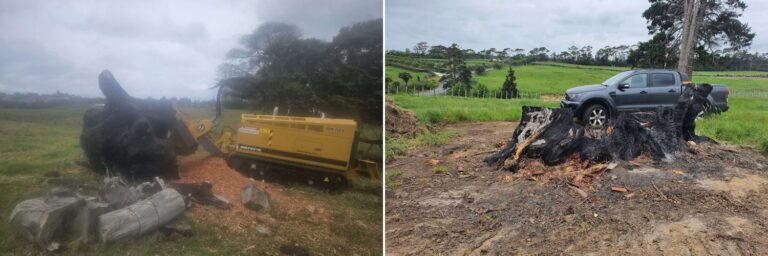
Once a belt is felled, what is left is a straight line of large stumps along the boundary. They stop a new fence going in on the old line, make mowing and spraying awkward, catch machinery in long grass and, with species such as poplar and willow, can send up regrowth.
Digging them out with an excavator works, but it leaves a trench of holes and disturbed ground, and a pile of root balls to deal with. Grinding them to or below ground level leaves the strip ready to fence, grass or plant, with the chip either raked back into the holes or spread.
A few planning points make the stump stage easier:
- Decide where the new fence or planting line will go before the stumps are ground, so the depth suits it
- Have the trees cut low and as square as practical, which makes the grinding quicker
- Book the stump work for when the ground is firm enough for a loaded trailer and a tracked machine
What Affects the Cost of Shelterbelt Removal
Shelterbelt jobs are quoted after someone has seen the trees, because no two belts are alike. The main factors are the length of the row, the height and trunk size of the trees, the species, access along both sides, how close the belt is to buildings, roads and power lines, what happens to the timber and branches, and how many stumps need grinding afterwards. Photos of the whole belt and the ground around it go a long way towards an accurate first estimate.
Where Apex Stump Grinding Fits
Apex Stump Grinding, run by Gary from Pukekohe, offers shelterbelt tree removal across Pukekohe and the surrounding rural areas, from selected trees or a short section through to a whole row, along with grinding the stumps that are left. Gary has a strong rural work background and looks at the trees, the access, nearby structures and fences, and the result you want before recommending trimming, part removal or full removal.
To get started, send the property address, a short description of the work and photos of the trees and the surrounding area through the contact page, or call Gary on 027 447 0533.